The First CAEP Physics Academic Exchange Conference Successfully Held — Uniting Strength to Build Strong Disciplines and Advance the Dream of a Technologically Powerful Nation
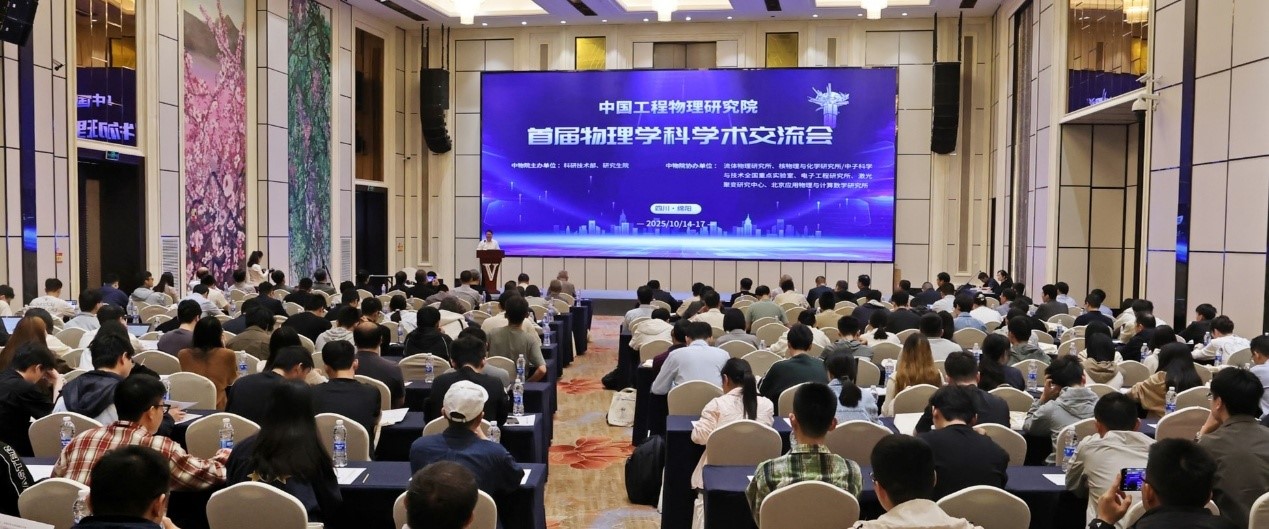
To thoroughly implement the national strategic deployment on strengthening basic research and to earnestly carry out the guiding principles of the 10th Party Congress of the China Academy of Engineering Physics (CAEP), the First CAEP Physics Academic Exchange Conference—hosted by the CAEP Science and Technology Department and the Graduate School of China Academy of Engineering Physics (GSCAEP)—was successfully held in Mianyang, Sichuan, from October 14 to 17, 2025.
On the morning of October 14, the opening ceremony was convened smoothly. Experts from within and outside CAEP, young researchers, postdoctoral scholars, and graduate students gathered to discuss frontier progress in physics and the future development of the discipline. Attendees included ZeYao Mo, Secretary of the CAEP Party Committee; Ming Huang, Vice President of CAEP; Academician Yuanning Gao of Peking University; Academician Hongwei Zhao of the Institute of Modern Physics, Chinese Academy of Sciences (CAS); Academician Zhong Fang of the Institute of Physics, CAS; and CAEP Academicians Minxing Luo, Qiang Wu, Hui Huang, and Changpu Sun. The opening ceremony was chaired by Academician Qiang Wu.
In his address, ZeYao Mo extended warm congratulations on the convening of the conference and expressed sincere appreciation to all experts and scholars who have long supported CAEP’s development. He emphasized that, in facing major national strategic needs and the mission of building a modernized strong military, CAEP’s undertakings confront new challenges that require comprehensive upgrading—especially in basic research, disciplinary development, and talent training—to build new scientific and talent strengths. He highlighted the importance of promoting CAEP’s future development through improvements in three dimensions: vertical integration, horizontal cross-disciplinary collaboration, and deep empowerment.
At the opening ceremony, Academician Changpu Sun delivered a keynote report titled “Third Quantization: Macroscopic Quantum Energy Levels and Their Coherent Quantum Superposition States,” offering an insightful interpretation of the 2025 Nobel Prize in Physics and setting a strong academic tone for the conference.
During the plenary invited talks, Academician Yuanning Gao, Academician Hongwei Zhao, and Academician Zhong Fang delivered keynote presentations titled “CP Violation: Discoveries and Challenges,” “High-Intensity Ion Accelerator Facilities and Their Applications,” and “AI + Materials Science: Opportunities and Challenges,” respectively. These talks showcased cutting-edge advances in frontier areas of physics and provided deep analysis of the relationships among basic research, engineering applications, and intelligent scientific development. The presentations sparked enthusiastic discussions among participating scholars. This session was chaired by Academician Minxing Luo.
From October 14 to 17, the conference featured four parallel sessions:
1. Frontiers of Quantum Physics
2. Complex Materials and Optoelectronic Technology
3. High-Energy Physics and Nuclear Physics
4. Strong-Field Physics (held concurrently with the 8th Workshop on Theoretical Issues in Strong-Field Physics)
A total of 72 invited experts presented specialized talks covering basic physics, materials science, quantum technologies, computational methods, and more. Additionally, 30 young researchers delivered oral presentations, engaging in deep academic exchanges and intellectual interaction with other attendees. The poster session held on the afternoon of October 16 showcased the achievements of emerging scholars, highlighting the vitality and creative potential of the younger generation in scientific research.
The successful hosting of this conference provided a high-level platform for academic exchange and disciplinary development. It also served as an important step toward integrating basic research with talent cultivation. Participating experts expressed hope that the conference would serve as a catalyst for further consensus-building, deepened collaboration, and higher-level interdisciplinary integration and innovation, contributing wisdom and strength to the advancement of China’s science and technology enterprise.